The San Diego County Binge and Underage Drinking Initiative
  • Home
  • About Us
  • Advisory Board
  • Events
  • Young Advocates
  • Resources
    • Newsroom
    • Status Report
      • 2025 (Current)
      • 2024
      • 2023
      • 2022
    • Testing Kits & Drink Lids
    • Expanded Footprint Assessment Tool
    • Recordings
    • Issue Briefs
      • Expanded Footprint Issue Brief
  • Contact Us
  • Menu Menu

Times of San Diego – Opinion: San Diego Needs to ‘Walk the Walk’ and Create Pedestrian-Friendly Neighborhoods

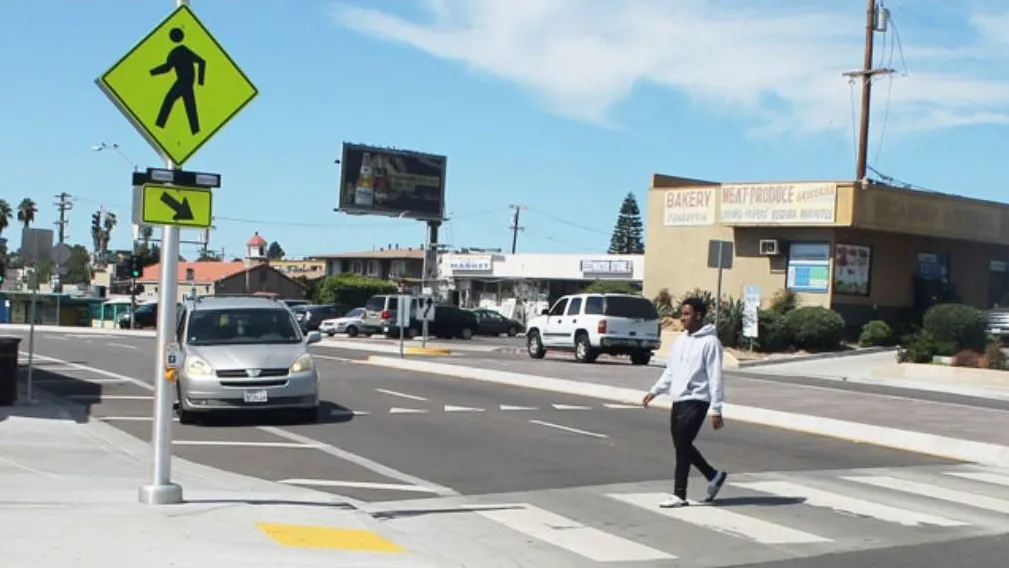
October 18, 2022/in news/by budisd

As seen in the Times of San Diego

Envision your ideal neighborhood. Imagine the kinds of businesses there, the entertainment spaces, the homes.

Now, in your perfect neighborhood, how far do you have to drive for essential services? How many miles to the nearest grocery store? Are the children living there walking to school, or do get dropped off in a long line of cars? These are the kinds of questions I like people to think about when they consider urban design and planning.

However, as many people working for the public will admit, activating individuals to imagine real change can be difficult. To do so, the problem that you solve has to create more pain than the fear of change.

As an urban designer and planner looking to change the way people think about their neighborhoods and communities, I know this fear of change is often one of the greatest challenges cities face. Out-of-control urban planning, and a major lack of comfortable, practical walking space, are often just accepted by communities that would benefit most from a change.

In a recent presentation, I spoke to community advocates about how city planning can be a powerful tool for creating safe, healthy spaces for San Diegans to live in. I explained that, like many places around the United States, San Diego communities are facing a crisis of poor planning as residential, commercial, and industrial hubs stretch up the coast connected by busy transportation corridors.

Think about the urban sprawl of homes and apartments, separated from the closest shopping, by busy streets and highways. This is the outcome of decades of zoning regulation in San Diego County that favored transportation, not people. As a result, many areas lack any reason — or hospitable space — for pedestrians to walk, leading to a slew of unintended consequences.

The negative effects of poor urban planning can often trickle down to communities in unexpected ways. For example, the “industrialization” and partitioning of drinking environments can create unsafe areas and exacerbate health issues.

For example, as communities stretch out further and further along transportation corridors, decreasing the number of commercial locations close to residential spaces, individuals are more likely to drive further to get drinks — and drink more while they are there. But in a community where smart planning has provided a reasonable number of accessible alcohol outlets in walking distance, individuals would not need to drive, and would be less likely to binge.

Policies like exclusive commercial-only zoning impact how customers interact with businesses, and can influence the vitality of an entire area of a city. Contrary to what many might expect, storefront parking requirements in many “main street” business corridors tend to have an overall negative effect on commerce in the area, rather than benefitting businesses. With storefront parking easily accessed from the street, it is more convenient for individuals to park, run into the store, and quickly leave.

I advocate a mixed-use city design that puts people before vehicles. Mixed-use zones are areas where commercial and residential buildings share space, rather than just one or the other. In these mixed-use spaces, smart urban planning can reduce the need for cars and protect spaces for pedestrians, further encouraging people to walk, bike, and utilize public transportation to get to places they need in a centralized space.

In my presentations I also demonstrate how conscientious transportation planning can address inequalities that often spring up in an urban environment. “Complete” streets are the best social justice tool a city can build, as these streets that create space for pedestrians, bicycles, and other transportation alternatives can reshape the way populations interact with their cities.

How our private buildings and businesses relate to our public streets and parks matters, and balance is the key to responsible urban planning that puts people first and creates places that residents actually want to inhabit. Local residents ultimately benefit — or suffer — from city planning, and the needs of residents don’t always align with how their neighborhoods are designed. That’s why community input is vital to good planning and zoning; every community is different, and only the people who live there can truly help make it home.

Howard Blackson is a San Diego architect, master planner and contributing faculty member at the NewSchool of Architecture & Design.

Share this entry
  • Share on Facebook
  • Share on X
  • Share on WhatsApp
  • Share on Pinterest
  • Share on LinkedIn
  • Share on Tumblr
  • Share on Vk
  • Share on Reddit
  • Share by Mail
https://budisd.org/wp-content/uploads/2022/10/Crosswalk-pic.webp 568 1009 budisd https://budisd.org/wp-content/uploads/2023/06/logo-budi-web-300x138.png budisd2022-10-18 00:56:112024-09-12 16:43:12Times of San Diego – Opinion: San Diego Needs to ‘Walk the Walk’ and Create Pedestrian-Friendly Neighborhoods

Pages

  • About Us
  • BUDI Advisory Board
  • BUDI Events
  • BUDI GIS Map
  • Contact Us
  • Contáctenos
  • Eventos de BUDI
  • Home
  • Inicio
  • Issue Briefs
  • Jóvenes Defensores
  • Newsroom
  • Panel de políticas sobre alcohol – Taller y reunión de la Asamblea General
  • Política de privacidad
  • Privacy Policy
  • Recordings
  • Resources
  • Sala de prensa
  • Sobre nosotros
  • Status Report
  • Términos y condiciones
  • Terms and Conditions
  • Testing Kits & Drink Lids
  • Young Advocates

Categories

  • news
  • noticias
  • Uncategorized

Archive

  • May 2025
  • December 2024
  • April 2023
  • February 2023
  • October 2022
  • December 2021
  • July 2021
  • January 2021
  • December 2020
  • October 2020
  • September 2020
  • May 2019
Institute for Public Strategies

8885 Rio San Diego Drive, Suite 117
San Diego, CA 92108

619-476-9100 | info@publicstrategies.org

The San Diego County Binge and Underage Drinking Initiative is funded by County of San Diego Health and Human Services Agency, Behavioral Health Services.

© Institute for Public Strategies. All Rights Reserved.
  • Terms and Conditions
  • Privacy Policy
Link to: CA ALCOHOL SERVERS TO TAKE TRAINING BY AUG. 31 – New California alcohol law promotes safer service—and indicates future policies Link to: CA ALCOHOL SERVERS TO TAKE TRAINING BY AUG. 31 – New California alcohol law promotes safer service—and indicates future policies CA ALCOHOL SERVERS TO TAKE TRAINING BY AUG. 31 – New California alcohol... Link to: The San Diego Union-Tribune – Opinion: Juneteenth is cause to celebrate, consider freedom Link to: The San Diego Union-Tribune – Opinion: Juneteenth is cause to celebrate, consider freedom The San Diego Union-Tribune – Opinion: Juneteenth is cause to celebrate,...
Scroll to top Scroll to top Scroll to top